


Why Do My Smile Lines Look Deeper Some Days? A Doctor's Honest Guide to Nasolabial Folds at Bella Medica
“Why do my smile lines look so much deeper some days?” I’m often asked this by people who notice them more in certain lighting or photos, when they’re tired, or first thing in the morning.
First, a little reassurance: these folds are part of how our faces are built. You can see them on children and teenagers, too. Having them does not mean anything has gone wrong.
The short answer is that a smile line can look different from day to day, but the underlying fold may also have more than one cause. That matters, because there isn’t one treatment that suits every face.
Three patterns can create a similar-looking fold
The nasolabial fold is the line running from the side of the nose towards the corner of the mouth. A 2024 open-access review by Hong and colleagues describes three broad patterns behind its appearance. This is a useful way to understand why two people with similar-looking smile lines may need different plans.

1. A volume difference. Sometimes the area beside the nose is naturally more recessed, including because of the shape of the underlying bone. The cheek next to it may look fuller by comparison, so the change in contour creates a step or shadow. In this pattern, supporting the hollowed area is the logic, not automatically filling the line itself.
2. Tissue that has begun to sag. The skin below the fold is relatively firmly attached around the mouth, while the tissue above it is looser. Over time, the fat above the fold can droop and bulge. The crease we see may be the edge of that bulge, rather than simply a wrinkle in the skin.
3. Movement when you smile. Some fibres of the muscles that lift the upper lip attach into the skin along the fold. When you smile, they pull on that skin and the line deepens. In younger faces, this may show mainly during smiling; after years of repeated movement, the skin can start to hold an imprint even at rest.
These patterns can overlap. The review notes that a combination, often sagging and movement together, is common. In my own assessments, most faces are a mix, which is exactly why a single approach rarely gives the best result.
Why I don’t simply fill every line
If the fold is mainly the edge of a drooping pad of fat, putting filler directly into the crease can add fullness without softening the shadow. In some faces, that can look puffy or heavy.
I would rather assess what is contributing to the fold than chase the line itself. Depending on the person, a plan might involve supporting the cheek, addressing movement, a combination of approaches, or honestly recommending less than someone expected, or no treatment at all. There is no correct answer for every face.
There is some research to support looking beyond the crease. In a 2017 open-label study, Gauglitz and colleagues placed hyaluronic acid filler in the upper and lower cheek of 18 patients, rather than directly into the folds. The measured depth of the nearby nasolabial folds reduced, with a maximum reduction of about 30% at three months; improvement was still measurable at twelve months.
That result is interesting, but it is not a promise of what will happen for an individual. The study was small, single-centre and had no control group. It also received writing support from the product’s manufacturer. I see it as useful supporting evidence, not proof that cheek treatment is right for everyone. Results in clinic vary from person to person.
What treatment at Bella Medica involves
Where treatment of the nose-to-mouth area is appropriate, I use hyaluronic acid dermal filler, assessed and planned around your features. My aim is to soften shadows and support the area, not simply plump the crease. You can read more about our dermal filler treatments.
If supporting the mid-face is a better plan, cheek filler may be considered separately after consultation. It is a separate treatment and is priced separately; it is not included in the nasolabial-fold treatment. You can find details about cheek filler.
Filler results are not permanent. Our service page describes results lasting up to around 18 months. Please treat that as a general guide: how long results last varies between people.
What about side effects and suitability?
There is no guaranteed result, and filler is not risk-free. A 2021 systematic review and meta-analysis of randomised trials on treatment of the nasolabial fold area reported temporary lumpiness, tenderness, swelling and bruising among the most common effects. These usually settle. I review my patients, and you can contact me if you have concerns. This is a well-studied treatment area, but rare, serious complications can occur too.
Filler may not be suitable during pregnancy or breastfeeding, with an active infection or skin inflammation in the area, or with a nearby skin infection such as a cold sore. If you have previous filler in the area that has not been assessed, please tell me before treatment. If you have significant asymmetry or an unexplained change, speak to your GP first. And if laxity is significant, filler cannot replace a surgical lift. I will say so if that is the more appropriate conversation.
A little about day-to-day changes
Sunscreen, moisturiser and not smoking support skin health. If you tend to wake with creases, sleeping on your back may help reduce pressure on your face overnight. These steps can help your skin generally, but they won’t remove a structural fold.
A consultation should give you clarity, not pressure
I offer a complimentary, no-obligation consultation, online or in person. I’ll ask about your health history and assess your whole face both at rest and in movement. I’ll explain what I think is contributing to your smile lines and give you an honest recommendation, including the option of no treatment.
If you decide to proceed, the appointment is one hour. I’ll explain your aftercare, and my post-procedure advice line is available if you need guidance afterwards: 01254 948849.
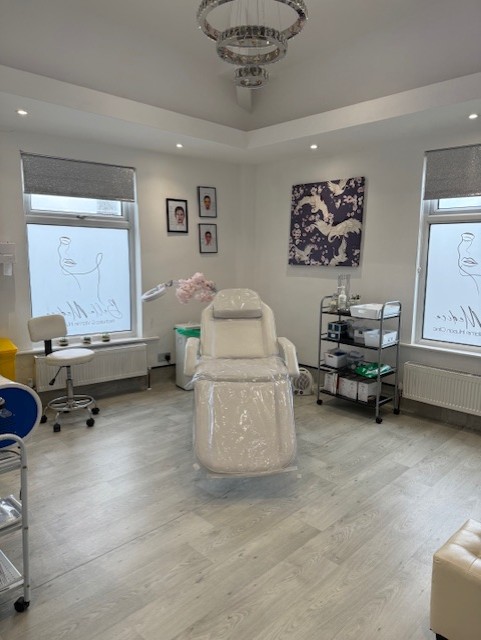
Genuine photo of our treatment room in Lancashire.
Treatment costs in Lancashire
As listed on our website on 16 November 2026, nose-to-mouth lines / nasolabial folds cost £270 for a one-hour appointment at our Blackburn and Barrowford clinics in Lancashire. A £50 deposit is required to book. Cancellations within 72 hours of the appointment result in the loss of the deposit paid, due to high demand.
Cheek filler is a separate, consultation-dependent option at £350 for one hour, with a £50 deposit to book. It is not part of the nasolabial-fold treatment price.

If you’re unsure what is making your smile lines look deeper, you’re welcome to book a complimentary consultation. We can talk through what you’ve noticed and what may, or may not, be helpful. Book online or contact Bella Medica.
Further reading: Hong et al., 2024, on the anatomy of nasolabial folds; Gauglitz et al., 2017, on cheek volume and fold depth; and Stefura et al., 2021, a systematic review and meta-analysis of filler treatment in the nasolabial fold area.
Comments