


Why Do My Temples Look Hollow? A Doctor's Honest Guide to Temple Filler at Bella Medica
“Why do my temples look hollow?” I’m often asked this after someone notices it in a photograph but can’t quite put a name to the change. And the next question is usually, “Can filler fix it?”
Sometimes it can help. But temple filler isn’t simply a case of filling every dip. The safest, most natural-looking plan depends on your face, your anatomy and what is causing the hollowing in the first place.
What are the temples, and why can they look hollow?
Your temples are the shallow areas on either side of your forehead, above your cheekbones and beside your brows. In a younger face, they often have a gently full, convex shape. With age, that fullness may reduce, making the brow bone and cheekbone edges look more prominent.
It’s largely a change in volume in the fat and soft tissue in the area. Genetics play a part too: some people are naturally more hollow at the temples, and that is normal. Weight changes can also make the hollowing more noticeable.
This isn’t usually a skin-quality problem. Creams and skin boosters may support the skin, but they won’t replace lost volume or fill a hollow.

Temple hollowing is one of those changes that can make the whole face appear more angular or tired, even when you’re a healthy weight. It’s also easy to notice in photos without knowing exactly what you’re seeing.
Can temple filler help?
Hyaluronic acid filler can be used to restore some volume in the temple and soften the transition from the brow to the cheekbone. At Bella Medica, I use a blunt cannula for this treatment rather than a sharp needle.
The aim isn’t to make the temples look puffy or to change your bone structure. It’s to create a subtle, balanced contour that sits naturally with the rest of your face.
Sometimes a small amount is enough. Sometimes the cheeks or mid-face also need to be considered to create a smooth overall transition; if that might apply, I may discuss cheek filler as a consultation-dependent option. And sometimes my honest advice is to leave the temples alone.
There isn’t one correct answer for everyone, and I can’t guarantee a particular result. Filler results are usually visible quickly, although swelling can take several days to settle. Filler isn’t permanent and typically softens over the months, with timing varying from person to person. You can read more about dermal fillers at Bella Medica.
Why does temple filler need particular care?
The temple is an area where detailed anatomical knowledge matters. There are named blood vessels and a nerve to the brow in this area, which is exactly why it is a doctor-led treatment. Even in experienced hands, risks include bruising, swelling, tenderness, lumps or irregularity, and, rarely, a vascular complication.
A 2020 open-access paper by Idone and colleagues in Plastic and Reconstructive Surgery – Global Open describes the layers of the temple, proposes a grading system for temple hollowing, and discusses a cannula technique placing filler in a relatively avascular plane between fascial layers. The authors reported 57 patients treated, with no major complications reported. They also noted that further studies are needed. This is one clinician group’s technique and experience, not proof that the procedure is risk-free. Read the paper.

Who may not be suitable?
Temple filler may not be appropriate if you’re pregnant or breastfeeding, or if you have an active infection or skin inflammation in the area. If you’ve had filler in your temples before and it hasn’t been assessed, we’ll need to discuss that first.
Significant asymmetry or unexplained volume loss also needs a careful look. If you’ve had unexplained weight loss, or are concerned about a possible medical cause such as a thyroid problem, please speak with your GP first. Filler is not intended to change your bone structure, and it isn’t a replacement for a surgical brow lift or fat transfer.
What happens at a consultation?
I offer a complimentary, no-obligation consultation online or in person. I’ll assess your face at rest and in movement, and look at your overall balance rather than focusing only on the hollow. We can discuss what you’ve noticed, what might be contributing to it, and whether treatment is appropriate for you.
If we agree to proceed, the appointment is one hour. I’ll explain the procedure and likely aftercare, and you’ll have access to my post-procedure advice line on 01254 948849. For the first 24 to 48 hours, avoid strenuous exercise, alcohol and other activities listed in our aftercare guidance.

Temple filler cost and booking in Lancashire
Temple filler costs £350 for a one-hour appointment and is available at both our Lancashire clinics in Blackburn and Barrowford.
Cancellations within 72 hours of the appointment lose the deposit paid because of high demand.
If you’re unsure whether temple filler is right for you, you’re welcome to get in touch about a consultation. You can also book an appointment online. My priority is to give you honest advice and help you make an informed choice, not to recommend treatment you don’t need.
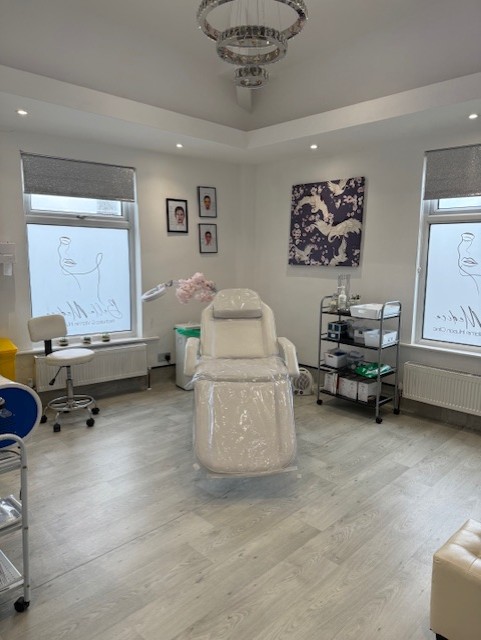
Genuine photo of our treatment room in Lancashire.
Comments