


The "Thread Queen" Guide: Why PDO Threads Are the Non-Surgical Lift You Need
- Nabilah Chowdhury
- Jan 23
- 5 min read
Updated: Jan 26
"Can I get a facelift without actually having a facelift?"
This is one of the questions I'm asked most often at our Blackburn and Barrowford clinics. And honestly? I completely understand why.
The idea of going under the knife, the lengthy recovery, the risks, the cost: it's a lot. But you're also looking in the mirror and noticing that things aren't quite where they used to be. Your jawline's lost some definition. Your cheeks have dropped a bit. Maybe your brows are sitting lower than they did five years ago.
Here's the good news: there's a brilliant middle ground. And it's called PDO thread lifting.
I've become known locally as "The Thread Queen of Lancashire" (a title I'm genuinely proud of!), and today I want to share everything you need to know about this treatment that's been transforming faces: without a single scalpel in sight.
What Exactly Are PDO Threads?
PDO stands for polydioxanone. Don't worry, there won't be a test on that.
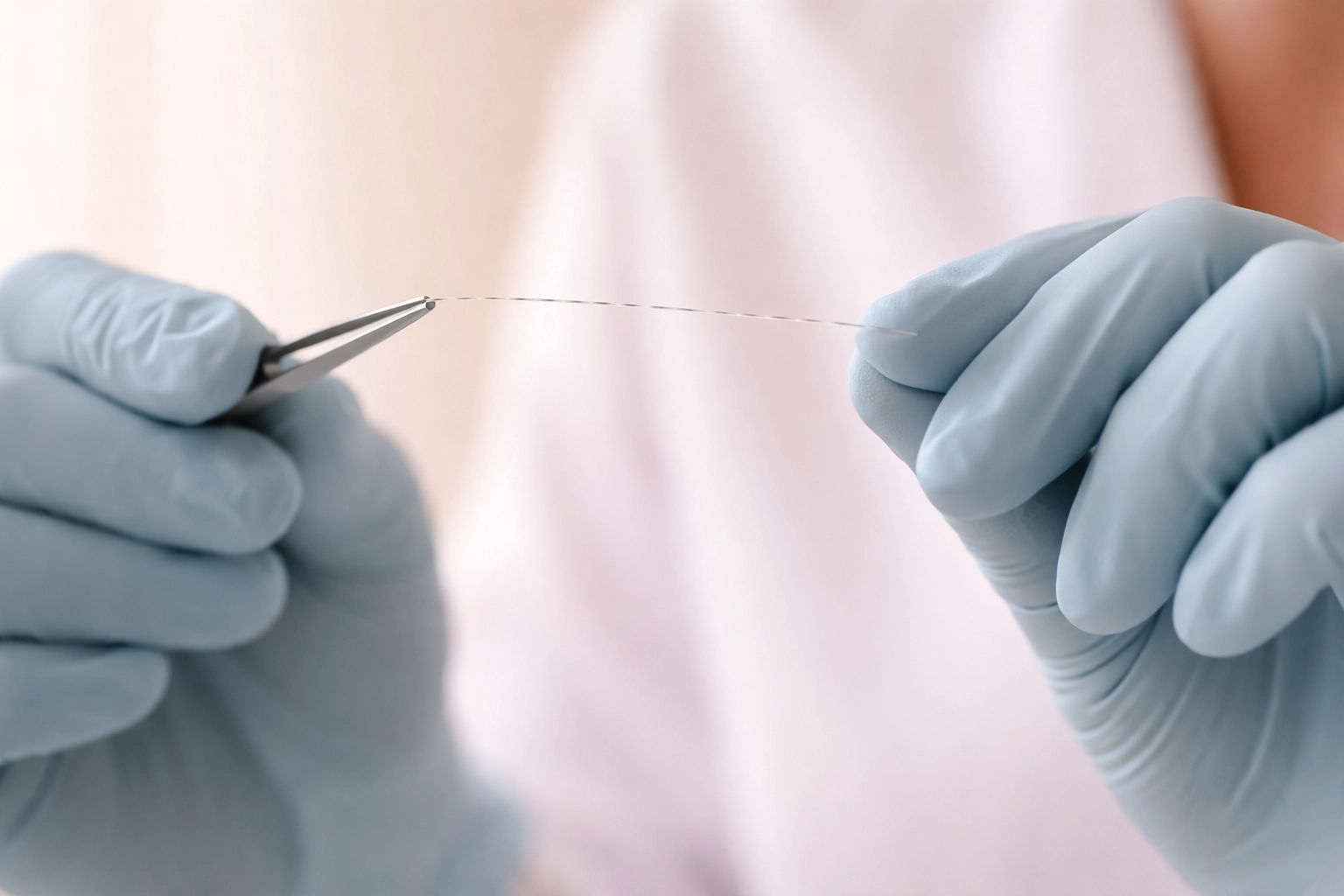
What matters is that these are medical-grade threads that have been used in surgery for decades. They're completely biocompatible, which means your body accepts them naturally, and they dissolve on their own over time.
The threads have tiny barbs along them that, when inserted beneath your skin, physically grip and lift sagging tissue. Think of them like tiny anchors holding everything in place.
But here's where it gets really clever.
The Science Behind the Lift
PDO threads do two things at once.
First, there's the immediate mechanical lift. The moment the threads are placed, they're physically repositioning your skin. You'll notice a subtle difference straight away.
Second: and this is the part I find fascinating: the threads trigger your body's natural healing response. Your skin starts producing fresh collagen and elastin around the threads, essentially rebuilding its own support structure from the inside out.
So while the threads themselves dissolve within 6–12 months, the collagen they've stimulated sticks around much longer. Most of my patients enjoy their results for up to three years, sometimes even longer.
It's not about creating an artificial look. It's about encouraging your skin to do what it was always capable of: just with a little help.
Why Choose Threads Over Surgery?
I have patients who come to me in their 40s, 50s, and 60s who simply aren't ready for surgical intervention. Some never will be, and that's absolutely fine.
Here's why PDO threads make sense for so many people:
No general anaesthetic. We use local anaesthetic to keep you comfortable. You're awake the whole time, which many people actually prefer.
Minimal downtime. The procedure takes 30–60 minutes, and most patients are back to their normal routine within a day or two. I usually recommend avoiding intense exercise and facial massage for about a week, but that's it.
Natural-looking results. This isn't about pulling your face tight like a drum. It's about subtle, refined lifting that makes you look refreshed: not "done."
Lower risk profile. When performed by an experienced, medically qualified practitioner, complications are rare. We're talking about a treatment with decades of safety data behind it.
Cost-effective. Let's be honest: a surgical facelift is a significant financial commitment. PDO threads offer genuine lifting at a fraction of the price.

What Areas Can Be Treated?
This is where it gets exciting, because PDO threads are incredibly versatile.
The most popular treatment areas I see at Bella Medica include:
Cheeks – restoring that youthful midface volume and lift
Jawline – redefining and sharpening a softened jaw
Jowls – addressing that heaviness that develops along the lower face
Neck – tightening loose skin and smoothing lines
Brows – giving a subtle lift to drooping brows without looking surprised
Under-eye area – improving the appearance of hollowing and fine lines
The number of threads used varies depending on what you're trying to achieve. Some areas might need just a handful; others might benefit from more. It's completely customisable to your face and your goals.
What Does the Procedure Actually Feel Like?
I won't pretend it's like having a facial. But it's nowhere near as uncomfortable as people expect.
Once the local anaesthetic has kicked in, most patients describe feeling a tugging or slight pressure sensation: nothing sharp or painful. Some people find it a bit odd, but definitely tolerable.
The whole thing takes under an hour for most treatment plans.
Afterwards, you might have some mild swelling or bruising for a few days. I always tell my patients to avoid big events for about a week, just to be safe. But many people go back to work the very next day.
When Will I See Results?
You'll notice a subtle lift immediately: that's the mechanical action of the threads doing their job.
But the real magic happens over the following weeks. As collagen builds around the threads, your results will continue to improve for about 6–12 weeks after treatment.
Think of it as a slow reveal rather than an instant transformation. This gradual improvement is actually one of the reasons results look so natural. There's no sudden change that screams "I've had something done."
Am I a Good Candidate?
PDO thread lifting works beautifully for men and women aged roughly 30–65 who have mild to moderate skin sagging.
You might be a great candidate if:
You've noticed your face "falling" but aren't ready for surgery
You want to address early jowling or a softening jawline
Your cheeks have lost their youthful position
You're looking for something more substantial than fillers alone
You want long-lasting results without significant downtime
It's not the right treatment for everyone. If you have very significant skin laxity, we might need to have an honest conversation about what's achievable. That's something I'll always discuss during your consultation: because realistic expectations are everything.
Why "The Thread Queen"?
I've been performing PDO thread lifts for years now, and it's become something of a passion.
What I love about this treatment is the precision it requires. Every face is different. The angle of insertion, the number of threads, the placement: it all matters. Getting it right takes experience, anatomical knowledge, and genuine artistry.
As a GP with over 20 years of medical experience, I bring a doctor-led approach to every treatment at Bella Medica. That means proper assessments, honest advice, and techniques backed by clinical training.
I've seen what poorly placed threads can do (usually from non-medical practitioners), and I've made it my mission to show Lancashire what thread lifting looks like when it's done properly.
Combining Threads with Other Treatments
PDO threads work brilliantly on their own, but they can also be part of a bigger plan.
Many of my patients combine thread lifting with dermal fillers to address both lift and volume loss. Others add anti-wrinkle injections or microneedling with skin boosters to maximise skin quality.
During your consultation, we'll talk through what combination (if any) makes sense for your concerns. There's no one-size-fits-all approach here.
Ready to Learn More?
If you've been curious about PDO threads: or you've been putting off doing something about that sagging jawline: I'd love to chat.
We offer consultations at both our Blackburn and Barrowford clinics, where we can assess your face, discuss your goals, and work out a plan that actually makes sense for you.
No pressure. No hard sell. Just honest, doctor-led advice from someone who genuinely loves what they do.
Pop over to bellamedica.co.uk to book your consultation, or give us a call. The Thread Queen is ready when you are.
Comments